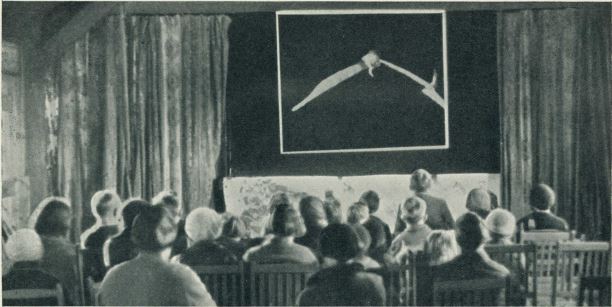
A headteacher attending a conference on ‘Children and the Cinema’ at the British Film Institute in 1946 observed that,
Here you have in the cinema a medium for mass entertainment as well as mass education, and I do not think you can separate those two much. They are so intertwined and linked with one another that you cannot see where entertainment ends and education begins. [1]
Secrets of Nature arguably contributed to this intertwining more than any films of the interwar period, rendering distinctions between ‘education’ and ‘entertainment’ practically meaningless. Their scripts never missed an opportunity to produce laughter, and the advent of sound saw the Secrets adopt a light-hearted and jocular tone, accompanied by up-beat music and narrations. The fact that the films were frequently shown as part of conventional evening cinema programmes demonstrates that they were treated by many viewers as entertainment. Secrets were usually played alongside other light-hearted ‘shorts’ in advance of the main feature, and were often listed alongside Disney cartoons. The producers behind the Secrets films were not always consistent about how they envisaged the position occupied by their films on the education/entertainment spectrum. On the whole, however, they were seen as principally entertainment films. As Mary Field expressed it in 1941, ‘every film was alive and vital, full of drama, was utterly unscientific, and each carried out the originator’s aim — to interest people in the world of nature about them. In short, they were grand entertainment.’ [2] But the films also had educational potential – the production company in charge of making the Secrets, was afterall, called British Instructional Films, and showbiz only partly explains their popularity.
Continue reading “Science and the ‘educational’ film”
 Secrets of Nature