Secrets of Nature films, like many other interwar shorts classed as ‘topical’ or ‘instructional’, were often played before the main feature film in cinema halls around the country. Whilst we know that their distribution was fairly widespread (see the interactive map), Mary Field and Percy Smith admitted that their films were often favoured in whatContinue reading “Non-Theatrical Cinemas”
Category Archives: Uncategorized
Amateur Natural History Films
Natural history has long carried an association with the word “amateur”. As a kind of ‘all-rounder’ science, natural history gained a ‘mass’ following in the nineteenth century, precisely when science began to attain a “professional” status. But distinguishing between amateur and professional is often a tricky business, and both categories have shifted significantly in definitionContinue reading “Amateur Natural History Films”
A ‘Secrets’ Pioneer? Rina Scott’s early films
Histories of film, and especially nature and wildlife film, often begin by repeating a common origin story. They start, usually, with Edweard Muybridge’s chronophotography experiments from the 1870s, which recorded sequential images of a horse’s gallop. The Secrets producers, however, drew a different genealogy when speaking of the historical origins of their filmmaking practice. InContinue reading “A ‘Secrets’ Pioneer? Rina Scott’s early films”
Online Workshop: Intermediality
Along with Anin Luo and Miles Kempton, I’ve spent the past couple of months organising an online workshop which will hopefully bring together a broad church of scholars interested in the history of science and media. Although we initially thought of proposing something very open and broad, we decided in the end to focus onContinue reading “Online Workshop: Intermediality”
The Nightingale (1932)
I am glad to hear that six new ‘Secrets of Nature’ are nearly complete and will be released before long. They are the best films of their kind ever made, and no other short British films have been so widely successful… But the greatest triumph of this new series is that the nightingale has madeContinue reading “The Nightingale (1932)”
Secrets of Empire
The Secrets of Nature films were produced at moment in British history – the interwar period – that can be interpreted as both the height, and the beginning of the ‘end’ of the British empire. As Andrew Thompson argues in Imperial Britain: The empire in British politics, c. 1880-1932, the inter-war years witnessed a deeperContinue reading “Secrets of Empire”
London Visitors (1936)
Recently I came across this wonderful image from the 1936 Secrets of Life film London Visitors (1936). With films like this one, which have not yet been digitized, we will have to make do for the moment with published photographs like the one above. Luckily, however, I was able to watch a viewing copy atContinue reading “London Visitors (1936)”
The Flight Machine (1930)
The Flight Machine (1930) was one of the first Secrets of Nature films to be filmed using sound. One of the more unusual films from the series, it demonstrates how the natural history genre could serve for a wide range of purposes, in this case as an exemplar of ‘applied science’. The film compares theContinue reading “The Flight Machine (1930)”
J. V. Durden and the Developmental Biology Film Series
Recently I have been updating some of the biographical sections on this site, and have been expanding the information on J. V. Durden, one of the key figures on the Secrets team in the 1930s, who directed many of the G.B.I. instructional films in biology. You can read the updated biographical page here, although please bear in mind that I’m constantly updating much of this information at the moment as I continue to build the site.
‘The New Learning’
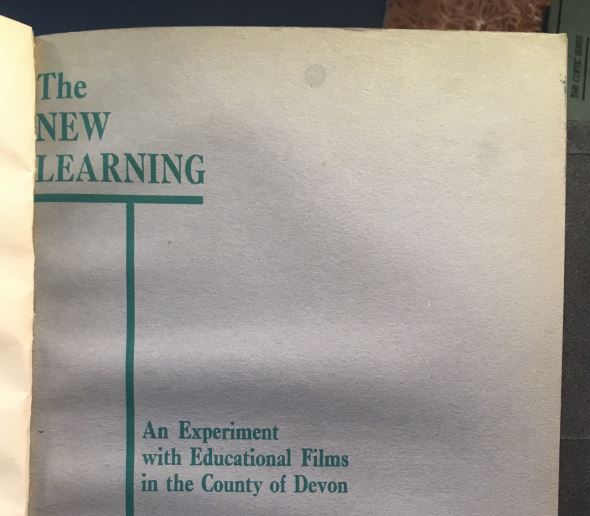
Recently I’ve been doing some writing about agricultural science films, and thought it may be interesting to write a post about one of my favourite Secrets of Nature primary sources. The New Learning: An Experiment wit Educational Films in the County of Devon is the name of a pamphlet published by the Workers’ Educational AssociationContinue reading “‘The New Learning’”
 Secrets of Nature